
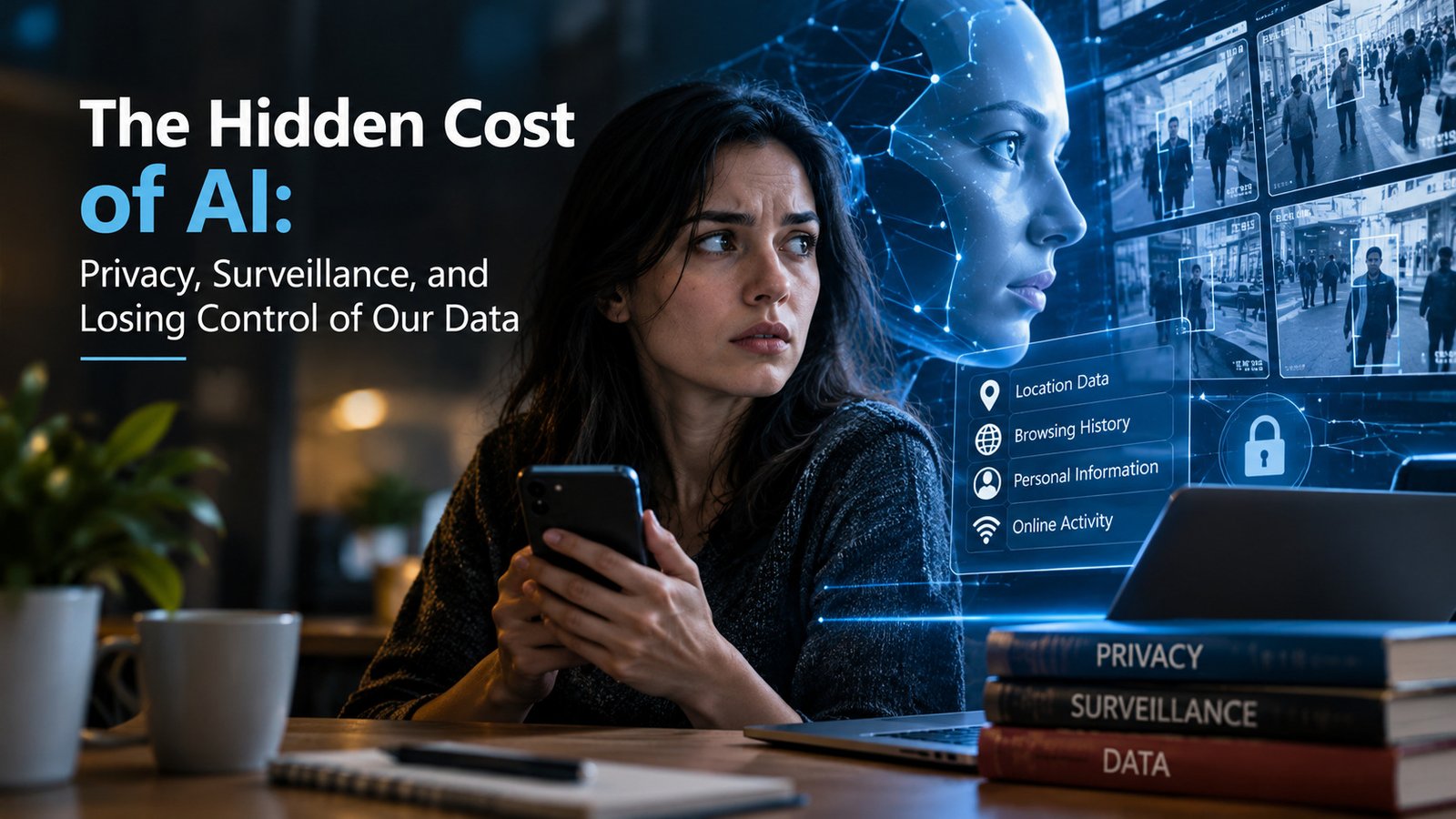
Have you ever talked about something out loud — a vacation idea, a product you needed — and then, almost eerily, an ad for that exact thing showed up on your phone minutes later? That unsettling little “wait, how did it know that?” moment is more common than ever, and it’s not really a coincidence. It’s a small glimpse into a much bigger issue: how much of our lives AI-powered systems are quietly watching, learning from, and profiting off of.
We talk a lot about AI’s ability to write essays, generate images, or answer questions. What gets far less attention is the massive appetite these systems have for personal data — and what happens to that data once it leaves our hands. Let’s pull back the curtain.
How AI Systems Collect and Use Personal Data
Every time you scroll, click, search, or speak to a smart device, you’re generating data. AI systems are designed to hoover up as much of it as possible, because more data means smarter, more “personalized” predictions.
Here’s where much of that data actually comes from:
- Browsing and search history — used to build detailed profiles of your interests, habits, and even your mood at different times of day.
- Voice assistants — devices that listen for “wake words” but, in some documented cases, have recorded snippets of conversation beyond what users expected.
- Apps and location tracking — many apps quietly track your location even when you’re not actively using them, building a map of your daily movements.
- Social media activity — likes, shares, and even how long you pause on a post are fed into algorithms that predict your behavior with startling accuracy.
Individually, each of these feels harmless. But stitched together, they create a profile of you that can be more detailed than what your closest friends know.
Facial Recognition and Surveillance Concerns
Perhaps nowhere is this more visible — literally — than in facial recognition technology. Cameras equipped with AI can now identify individuals in crowds, track movement across a city, and cross-reference faces against massive databases in seconds.
Some governments use this technology for public safety, arguing it helps catch criminals and prevent crime. But civil liberties groups warn it opens the door to mass surveillance, where ordinary citizens are tracked without consent, without a warrant, and often without ever knowing it happened.
There’s something deeply unsettling about walking down a street and realizing a machine somewhere is quietly identifying you, logging your location, and storing that information indefinitely. It raises a hard question: how much freedom are we willing to trade for a sense of safety?
Data Breaches Involving AI-Powered Platforms
Here’s the part that should genuinely worry you: all that collected data has to be stored somewhere, and that somewhere isn’t always secure.
- AI platforms — especially newer startups racing to build features quickly — have suffered data breaches exposing user conversations, personal details, and even uploaded files.
- Some breaches have revealed that AI chat logs, which many people assume are private, were stored, reviewed, or leaked far more broadly than expected.
- Once data is breached, there’s no putting it back. It can be sold, used for identity theft, or simply exist in an archive somewhere, forever out of your control.
It’s a sobering reminder that convenience often comes with strings attached — and those strings aren’t always visible until something goes wrong.
Who’s Really Profiting From Your Information?
Here’s an uncomfortable truth: your data isn’t just being collected — it’s being sold. Advertising companies, data brokers, and even AI companies themselves often generate massive revenue from user data, packaged and repackaged in ways most people never fully understand or agree to.
That “free” app or that AI tool you use every day? In many cases, you’re not really the customer — you’re the product. Your habits, preferences, and personal details are the actual commodity being traded behind the scenes.
This doesn’t mean every company is acting maliciously. Many operate within legal boundaries and disclosed terms. But “legal” and “fair” aren’t always the same thing, and most users simply don’t read the fine print closely enough to know what they’ve agreed to.
Simple Steps to Protect Your Privacy
The good news? You’re not powerless here. A few small habits can make a real difference in how much of your life ends up in someone else’s database.
- Review app permissions regularly — turn off location access, microphone access, and contact access for apps that don’t truly need them.
- Use privacy-focused browsers and search engines — many are built specifically to avoid tracking your activity.
- Read privacy policies for major tools you use daily — at least skim the sections about data sharing and third parties.
- Limit voice assistant usage for sensitive conversations, and periodically delete stored voice recordings if your device allows it.
- Use strong, unique passwords and two-factor authentication to reduce the damage if a breach does occur.
None of these steps make you invisible — full privacy in today’s world is genuinely difficult to achieve. But small, consistent habits add up to real protection over time.
Conclusion
AI has undeniably made life more convenient — from smarter recommendations to faster searches. But that convenience comes at a cost most people never fully see: a steady, quiet erosion of privacy. The more we understand how our data is collected, stored, and sometimes exposed, the better equipped we are to protect ourselves.
You don’t have to unplug from modern technology to take back some control. A few mindful habits, a little skepticism about what you share, and regular privacy check-ins can go a long way. In a world where machines are always watching and listening, awareness itself has become one of the most powerful tools you have.
Frequently Asked Questions
1. Is my data really being sold by AI companies? In many cases, yes — either directly or through data broker partnerships. Terms of service usually disclose this, but the language is often vague enough that most users don’t realize the extent of it.
2. Can I stop AI from tracking me completely? Not entirely, but you can significantly reduce it by limiting app permissions, using privacy-focused tools, and being selective about which AI services you use for sensitive information.
3. Are voice assistants always listening? Most are designed to activate only after a wake word, but there have been documented cases of accidental recordings. Reviewing and deleting stored voice data periodically is a good precaution.
4. Is facial recognition surveillance legal? It varies significantly by country and region, with some places imposing strict regulations and others allowing broader use. It’s worth checking your local laws if this concerns you.
5. What’s the single most effective privacy step I can take today? Reviewing and restricting app permissions (location, microphone, contacts) is one of the fastest, most impactful changes most people can make in just a few minutes.