
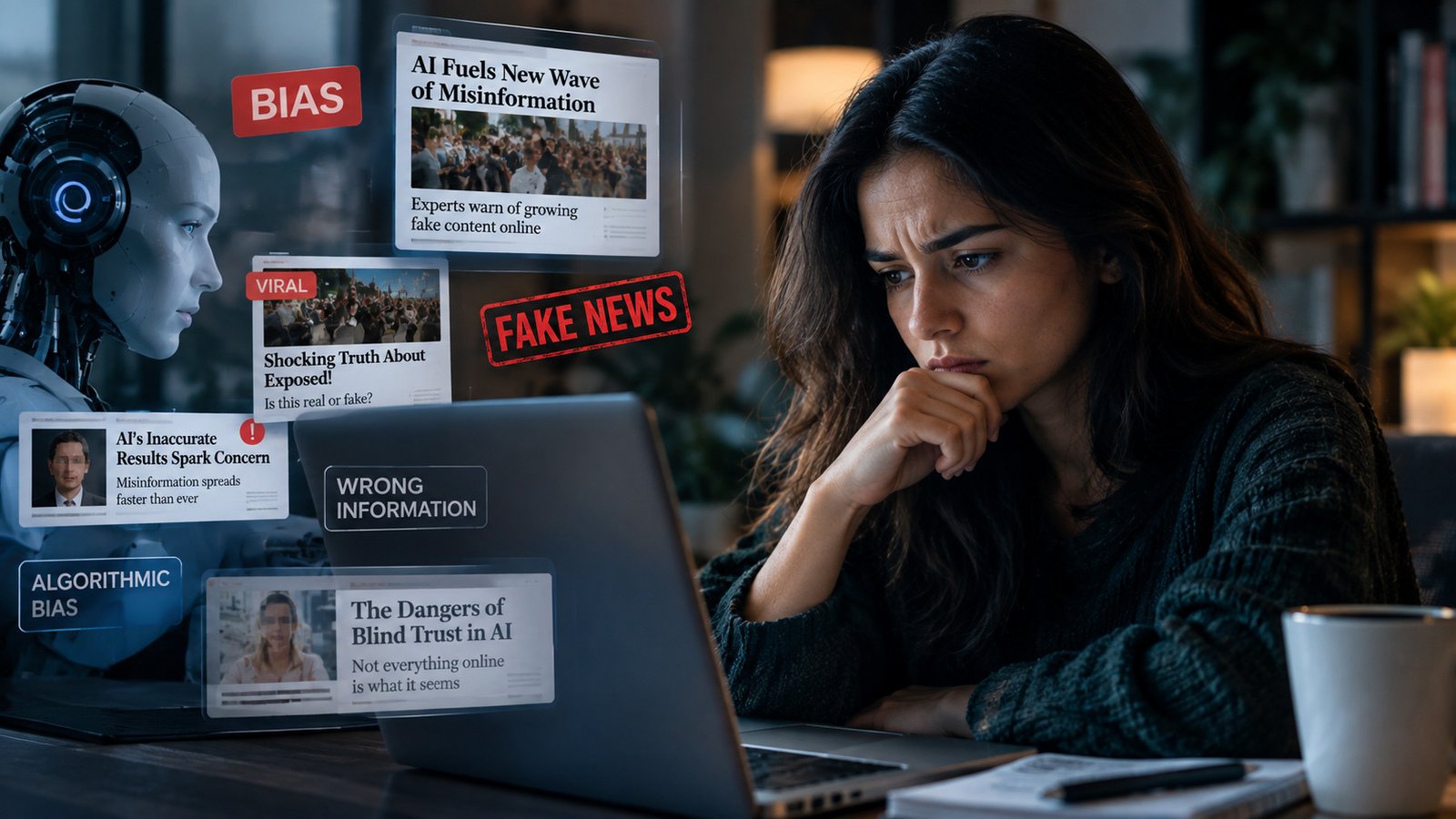
Imagine applying for a job you’re perfectly qualified for, only to get rejected before a human ever reads your resume — because an AI screening tool flagged your application for reasons it can’t even explain. Or imagine seeing a video online that looks completely real, showing someone saying something they never actually said. These aren’t hypothetical fears anymore. They’re happening right now, and they reveal one of AI’s most dangerous blind spots: it can be confidently, convincingly wrong.
We tend to trust technology because it feels objective — numbers, algorithms, cold logic. But AI systems are built by humans, trained on human-generated data, and that means they inherit human flaws too, sometimes amplifying them at a scale no individual person ever could. Let’s look at where this goes wrong, and why blind trust in AI can be genuinely risky.
Real Cases of AI Bias in Hiring, Lending, and Policing
Bias in AI isn’t a theoretical concern — it’s been documented repeatedly across major industries.
- Hiring: Some AI recruiting tools have been found to favor resumes similar to those of previously successful (often majority-group) employees, unintentionally penalizing qualified candidates from different backgrounds.
- Lending: Automated credit-scoring systems have shown patterns of offering less favorable loan terms to certain demographic groups, often reflecting biases baked into historical lending data.
- Policing: Predictive policing tools, which flag “high-risk” areas or individuals, have faced criticism for disproportionately targeting minority communities, reinforcing existing patterns of over-policing rather than correcting them.
In each case, the AI wasn’t intentionally programmed to discriminate. It simply learned patterns from historical data — and history, unfortunately, is full of bias. The danger is that AI can launder that bias through a veneer of objectivity, making it harder to question or challenge.
How AI Spreads Misinformation at Scale
Beyond bias, there’s another growing problem: AI’s ability to generate convincing but false information, quickly and at massive scale.
- Language models can produce text that sounds authoritative and well-researched, even when the underlying facts are wrong or entirely fabricated.
- AI-generated articles and social media posts have been used to flood platforms with misleading content, sometimes designed specifically to manipulate public opinion.
- Because this content can be produced far faster than human fact-checkers can review it, misinformation often spreads before corrections ever catch up.
The unsettling part isn’t just that AI can be wrong — it’s how convincing that wrongness can sound, wrapped in confident, articulate language that discourages skepticism.
Deepfakes and the Erosion of Truth Online
Perhaps the most alarming example of AI misuse is the rise of deepfakes — AI-generated videos or audio that convincingly mimic real people saying or doing things they never actually did.
Deepfakes have already been used to:
- Create fabricated statements from public figures, sometimes for political manipulation
- Generate fraudulent audio impersonating executives to authorize fake financial transactions
- Produce non-consensual content targeting private individuals
As this technology improves, the line between “real” and “fabricated” becomes harder to detect with the naked eye or ear. That has a chilling ripple effect: even genuine footage can now be dismissed as “probably fake,” making it harder for society to agree on a shared version of the truth at all.
Why “The AI Said So” Isn’t Good Enough
There’s a natural human tendency to trust confident-sounding answers, especially from something that appears advanced and objective. But AI systems don’t inherently “know” the truth — they generate the most statistically likely response based on patterns in their training data.
This means an AI can:
- Sound completely certain while being factually wrong
- Present biased conclusions as if they were neutral facts
- Lack the ability to explain why it reached a particular decision, especially in complex systems like hiring algorithms
Treating AI output as automatically correct — without questioning it — is where real harm tends to creep in. Confidence is not the same as accuracy, no matter how polished the response sounds.
How to Fact-Check and Think Critically in an AI-Saturated World
The good news is that a few simple habits can dramatically reduce your risk of being misled.
- Verify important claims through multiple independent sources, especially before sharing information further.
- Be skeptical of content that seems designed to provoke strong emotion — outrage and shock are often used to bypass critical thinking.
- Reverse image or video search suspicious media to check whether it’s been altered or taken out of context.
- Ask AI tools to explain their reasoning when possible, and treat vague or unverifiable answers with caution.
- Support and rely on credible journalism and fact-checking organizations, which increasingly specialize in identifying AI-generated misinformation.
Critical thinking isn’t about rejecting AI outright — it’s about staying an active participant in evaluating information, rather than a passive recipient of whatever sounds most confident.
Conclusion
AI has incredible potential to inform, assist, and simplify complex tasks — but it’s not infallible, and treating it as an unquestionable authority can lead to real harm, from biased hiring decisions to the spread of convincing misinformation. The solution isn’t to distrust AI entirely, but to approach it the way you would any powerful tool: with healthy skepticism, a habit of verification, and an understanding that confidence in a response is not proof of its accuracy. In a world where machines can sound remarkably sure of themselves, staying a critical thinker has never mattered more.
Frequently Asked Questions
1. Can AI bias be completely eliminated? Not entirely, since AI learns from historical human data that often contains embedded bias. However, careful auditing, diverse training data, and human oversight can significantly reduce it.
2. How can I tell if a video or image is a deepfake? Look for unnatural blinking, inconsistent lighting or shadows, mismatched audio timing, and blurring around the edges of a face. Reverse searching the content can also help verify its origin.
3. Why do AI systems sound so confident even when they’re wrong? AI language models are designed to generate fluent, natural-sounding responses based on patterns in data, not to assess their own certainty the way a human expert would.
4. Are companies held accountable for biased AI decisions? It varies by industry and region. Some sectors, like lending and hiring, face increasing regulatory scrutiny, but enforcement and transparency standards are still evolving in many places.
5. What’s the easiest first step to avoid AI misinformation? Pause before sharing anything that triggers a strong emotional reaction, and take a moment to verify it through at least one independent, credible source.